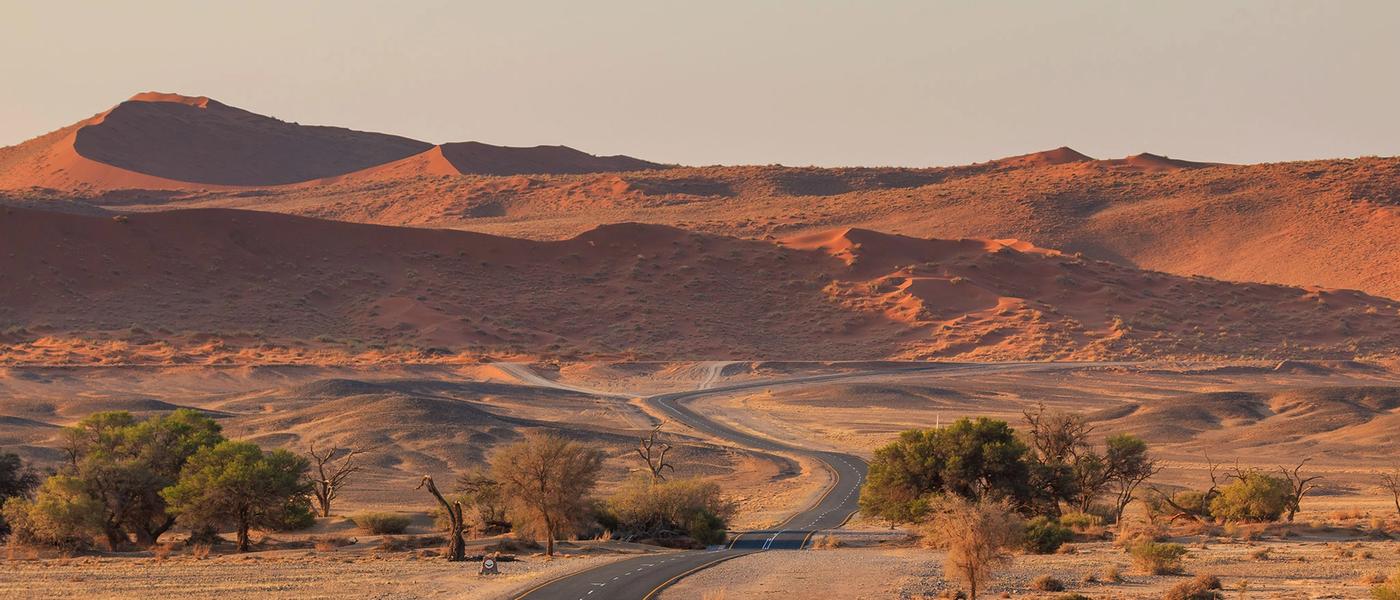

The tar road disappears in the rear-view mirror, replaced by gravel roads stretching towards mountains that seem to belong to another planet. Hours pass without another town. Sometimes the landscape is all ochre and stone. Then it morphs, stone sprouting into grassland, until they sweep into endless, towering dunes. And somewhere along that road, Rhino Africa Travel Expert Peggy Bzinkiewicz realised that the road itself is not a means to an end. It’s one of Namibia’s greatest attractions.
The Preview
Peggy first visited Namibia many years ago with a group of friends – ten people squished into two compact Polo cars. They drove from Cape Town into the vast Namibian terrain, and it's a journey that has left the dusty fingerprints on her heart ever since.
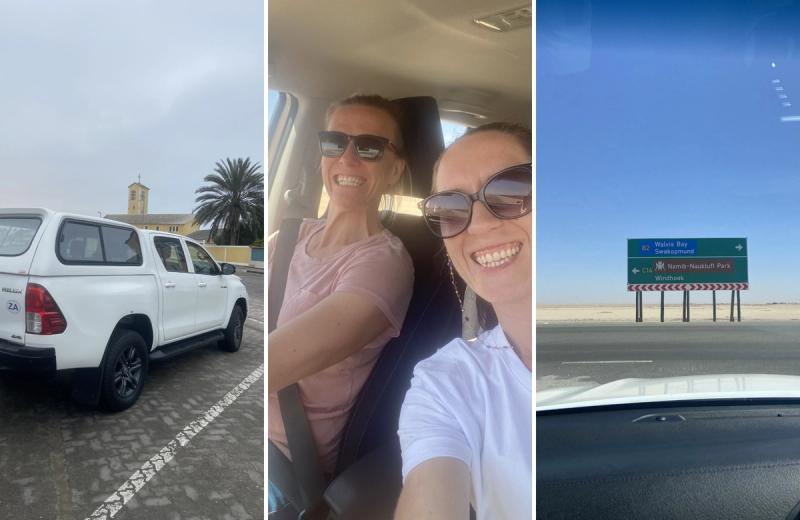
Her latest trip looked rather different. Instead of ten friends squeezed into two tiny hatchbacks, it was just Peggy and her colleague, Julia Harker, setting off in a sturdy double cab.
Of course, she was excited to revisit the iconic landmarks that put Namibia on the global map, but as soon as she was behind the steering wheel, the road stretched ahead with no timetable to keep, no traffic to outrun, and nowhere she needed to be except the next horizon, and she discovered that driving isn't a logistical compromise. It's the experience.
Kilometre by kilometre, Namibia unveiled itself before her eyes, and her expectations melted away under the African sun.
Chapter One: Where Namibia Begins
Every great road trip begins with a small moment of uncertainty. For Peggy, it wasn't the extended distances or the gravel roads that gave her pause. It was the vehicle waiting outside the rental office in Walvis Bay, a small city on Namibia's western coastline.
"It was the size of the car that intimidated me. I'd never driven a double cab before."
Within half an hour, that uncertainty had begun to disappear.
Before handing over the keys, the rental team walked Peggy through everything she needed to know, from navigating gravel roads and changing a tyre to what to do if she needed roadside assistance. What had felt daunting quickly became manageable.
It set the tone for everything that followed.
For all Namibia's reputation as an adventurous self-drive destination, Peggy discovered that it's remarkably well set up for independent travellers. From comprehensive vehicle handovers to dependable roadside support, every step is designed to give first-time visitors the confidence to get behind the wheel and explore at their own pace.
With the formalities behind them, Peggy and Julia pointed the vehicle west towards the Atlantic.
Cruising to the Coast
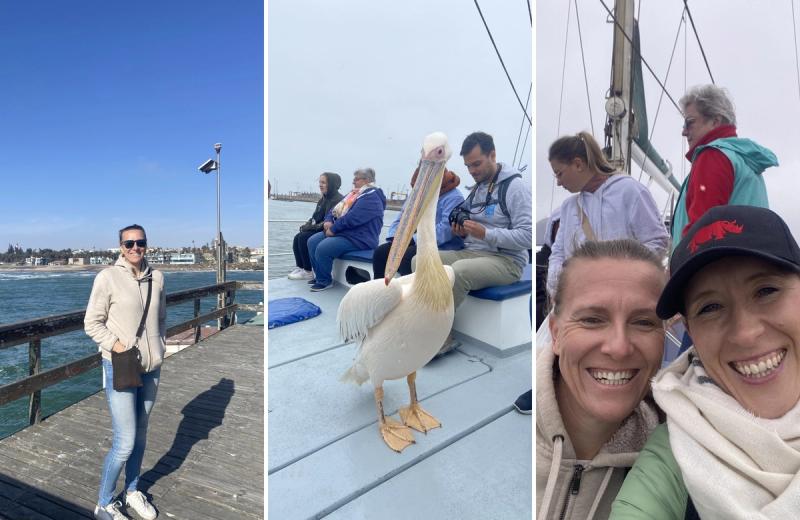
Their first stop was Swakopmund, where German colonial architecture meets the wild Namibian coastline, and where the desert first reveals that it has more than one personality.
After settling into The Delight, a bright, contemporary hotel whose playful turquoise and red interiors mirror the colourful character of the town itself, they set out early the following morning for a boat cruise in Walvis Bay.
Wrapped in blankets aboard a catamaran, warming their hands around mugs of hot chocolate (with the occasional splash of sherry courtesy of the crew), they watched dolphins, pelicans, and curious Cape fur seals weaving through the bay. It was a gentle introduction to Namibia's coast, but the day's biggest surprise was still to come.
That afternoon, they swapped the driver's seat for the passenger seat as a local guide took the wheel for the venture to Sandwich Harbour. Peggy had imagined a leisurely drive through scenic dunes. Instead, she found herself gripping the sides of the 4x4 as it climbed undulating sand dunes before plunging back towards the Atlantic, where golden desert meets crashing ocean.
"It wasn't at all what I expected. I thought it would be a quiet drive through the dunes. Instead, it was a proper guided off-road 4x4 excursion."
The ride is best suited to adrenaline seekers, Peggy admits. But standing high above the coastline, watching the dunes tumble into the Atlantic, she realised that Namibia had already started doing what it would continue to do for the rest of the journey: surprise her.
Chapter Two: Where the Road Becomes the Destination
Self-drive day arrived. Taking to the roads, Peggy thought she knew what lay ahead: endless desert stretching towards the horizon. Flat. Empty. Predictable.
Instead, the landscape refused to stand still.
The kilometres carried her through pockets of unexpected greenery, rugged mountains, winding passes, volcanic hills, and rocky escarpments. With every turn, Namibia showed another side of itself, slowly dismantling every assumption she'd arrived with.
As the scenery changed, so too did her mindset. She stopped thinking about the next destination and started paying attention to the journey itself. Pulling over became second nature. Not because she had to, but because the vistas kept asking her to.
The corrugated gravel roads demanded patience, with some stretches slowing her to little more than 20 km/h. Yet what first felt like an inconvenience soon became one of the greatest gifts of the trip. Moving slowly gave her time to notice the details, absorb the immense scale of the topography, and appreciate just how dramatically Namibia changes from one region to the next.
Surrounded by ancient mountains, open skies, and landscapes shaped over millions of years, she felt wonderfully small – a reminder that Namibia isn't simply a destination to visit, but one to travel through.

Chapter Three: Meeting the Desert
The road eventually led to the scenery most people picture when they think of Namibia. Dominating apricot dunes. Limitless blue skies. Ancient camelthorn trees standing motionless against a sea of ochre sand.
But Peggy resisted the temptation to rush straight towards Sossusvlei's famous landmarks. After days spent learning to slow down, she wanted to experience the region the same way she had experienced the road itself: patiently.
Her first stop was Sossusvlei Desert Lodge.
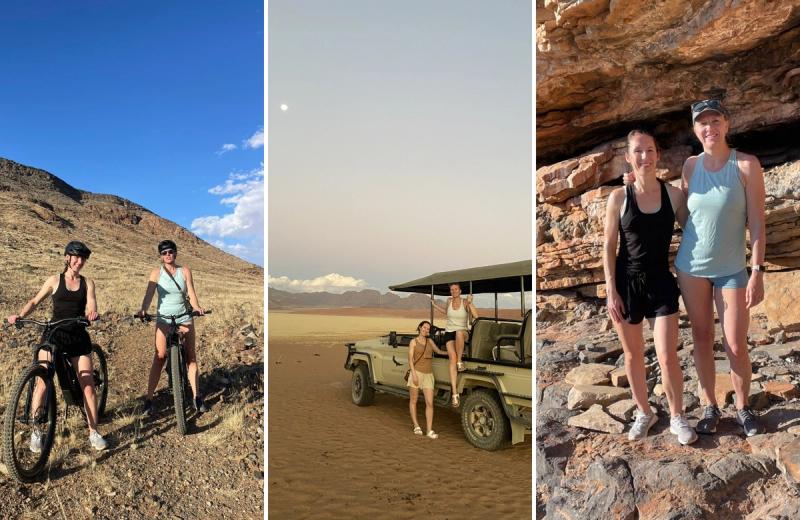
Rather than spending the day driving to the national park, she immersed herself in another side of the Namib. Guided nature drives revealed wildlife uniquely adapted to survive in one of the world's oldest deserts.
Sunrise walks transformed nearby dunes into shifting canvases of amber, rose, violet, and gold. Ancient rock art told stories of people who had crossed this landscape thousands of years earlier, while electric-bike excursions offered yet another way to explore the reserve.
"It's one of the few places where I could happily spend a week. The lodge itself becomes part of the destination."
She was equally struck by the intuitive service. Staff remembered favourite drinks from arrival, tailored menus around dietary requirements, and somehow managed to serve beautifully fresh seafood despite being surrounded by hundreds of kilometres of desert.
Discovering the Desert’s Depth
The next leg of their trip took them to Little Kulala.
Where Sossusvlei Desert Lodge celebrates contemporary luxury, Little Kulala feels more deeply woven into its surroundings. Timber, canvas, and natural textures soften the architecture, while its private gate into the national park offers something even more valuable: early access to Sossusvlei before the crowds arrive.
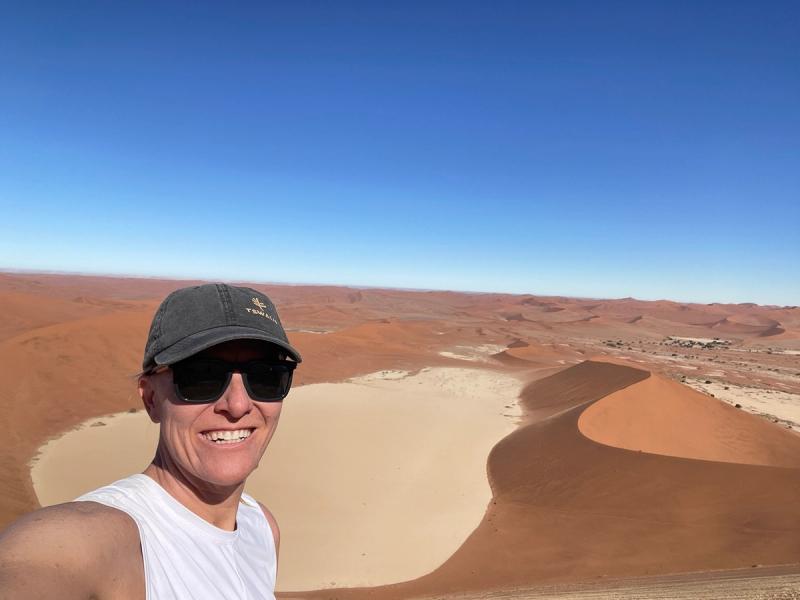
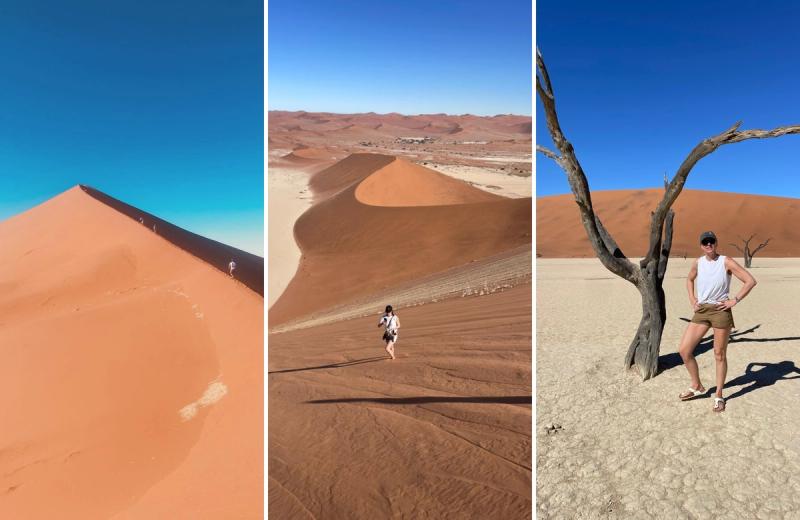
That meant Peggy and her guide reached Big Daddy (Sossusvlei's tallest dune) before the first tour buses arrived. With only a handful of people on the ridgeline, each step sank into the cool morning sand in near silence, an atmosphere that made the sheer scale of the Namib feel even more profound.
"The view is incredible. But going down was actually my favourite part."
Running down the dune became pure childlike joy before she landed among the ancient camelthorn trees of Deadvlei – one of Namibia's most photographed landscapes, yet one whose scale and stillness no image can truly capture.
By the time she left Sossusvlei, Peggy discovered its most popular attraction isn't any single landmark. It's the countless ways you can immerse yourself in one of the world's most extraordinary environments.
Chapter Four: Learning to Disconnect
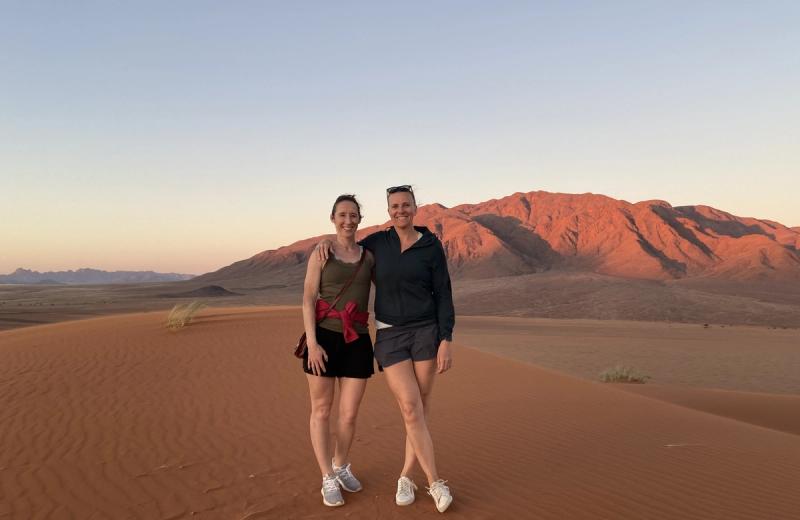
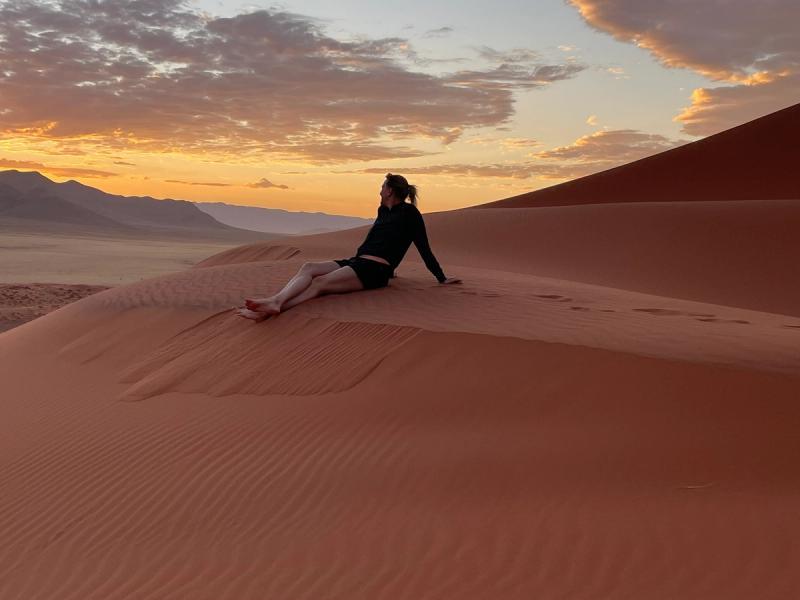
Back on the road, Peggy ventured deeper into the NamibRand Nature Reserve, where upswept dunes give way to rocky escarpments, hardy shrubs, and expansive golden grasslands. Once again, Namibia revealed an entirely different side of itself.
But it wasn't only the landscape that changed. The road that had gradually encouraged Peggy to slow down now seemed to ask her to stop altogether.
At Wolwedans Dune Camp, there’s little to distract from the wilderness. No Wi-Fi in the suites, no constant stream of notifications. Just the occasional ostrich or oryx crossing the plains and a silence that stretches as far as the eye can see.
"You don't come here for the wildlife. You come here to disconnect from the world."
Unlike many destinations where luxury is measured by what’s added, Wolwedans strips everything back. Time stretches a little longer. Conversations go a little deeper. And even the silence forms an integral part of the experience.
As evening falls, the reserve reveals perhaps its grandest spectacle. NamibRand is one of the world's largest International Dark Sky Reserves, protected from light pollution and celebrated for its extraordinary stargazing. Looking up, Peggy found herself beneath a sky so crowded with stars it hardly seemed real.
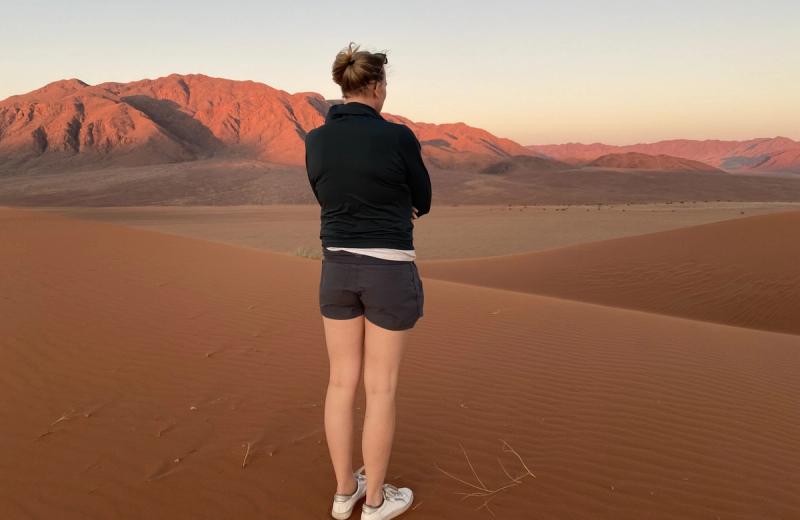
For a moment, the same feeling that had followed her since leaving Walvis Bay returned once again. The immense scale of Namibia has a remarkable way of making you feel utterly, and almost comfortingly, small.
Chapter Five: All Roads Point Home
For Peggy, the journey back offered one final chance to reflect on everything Namibia had taught her.
When she first collected the keys in Walvis Bay, her mind was full of practical questions. The size of the vehicle. The gravel roads. The long distances. Would it feel safe? Would driving be as daunting as she'd imagined?
By the time she handed those same keys back, those concerns had faded into the background.
"They're still realities. The roads can be rough. The distances are long. But that's part of Namibia. Once you stop trying to rush through it, everything changes."
Looking back, Peggy realised that the very things many guests worry about had become the parts she treasured most.
"I think Namibia is a destination that should be driven. It's the only way you truly understand how vast it is, and just how small you are within it."
Perhaps that's why Namibia stays with people long after they've left. Here, luxury isn't found in a lodge or a landmark. It's found somewhere between them – in the freedom of the open road.
Ready to Hit the Road?
Namibia isn't a destination to rush through. It's a country that rewards curiosity, patience, and the freedom to follow the road wherever it leads.
Whether you dream of climbing the dunes of Sossusvlei, watching the Atlantic Ocean collide with the desert at Sandwich Harbour, or simply experiencing the magic of Namibia's ever-changing scenery, we'll help you build a self-drive journey tailored to your pace, interests, and travel style.
Explore our expertly crafted Namibia self-drive itineraries, or speak to one of our Travel Experts to start planning your own adventure.
Feature Image Credit: Tomasz Wozniak